
Understanding the Purpose of the Podcast
Season 5, Episode 10 explores how early Latter-day Saint history is reconstructed through primary sources and careful historical method. The podcast emphasizes that genuinely understanding Joseph Smith and the Restoration requires direct engagement with journals, dictated manuscripts, document collections, and independent accounts. Rather than relying on modern speculation or revisionist reinterpretation, the hosts rely on original sources from the 19th century to clarify what Joseph Smith taught, how revelation functioned, and what early Saints actually experienced.
How Historians Evaluate Early Latter-day Saint Sources
The episode explains that authentic historical reconstruction demands more than quoting a line here or there. Scholars examine broad patterns across independent documents—journals kept at the time, letters written by multiple eyewitnesses, manuscript histories, and the accumulated testimonies of early Church members. Reliability is strengthened when several unrelated sources confirm the same details, and weakened when an isolated recollection contradicts dozens of contemporary accounts. Trained historians therefore assess not only what a source claims, but when it was written, why it was written, and how it compares to other evidence.
Joseph Smith and Plural Marriage: What the Sources Actually Show
The podcast emphasizes that historical evidence for Joseph Smith’s teaching and practice of plural marriage is extensive. Eyewitness accounts from faithful members, critics, family members, and later dissenters consistently affirm it, with contemporaneous journals and firsthand testimonies providing direct documentation. A small number of late denials—mainly from Emma Smith—appear decades afterward, conflict with earlier evidence, and contain factual errors. As a result, historians weigh the full body of contemporary sources rather than privileging a few late, contradictory statements.
The Historical Record of Joseph Smith’s Translation Methods
The Book of Mormon translation process is described consistently across independent 19th-century testimonies. Emma Smith, Oliver Cowdery, David Whitmer, Joseph Knight Sr., and several others reported that Joseph used both the Urim and Thummim and a seer stone placed in a hat to block ambient light. These descriptions appear across decades of retellings and come from individuals who later disagreed with each other on many subjects, yet who remained united in describing Joseph’s translation method. The historical record is therefore remarkably stable: Joseph translated through divine instruments, including a seer stone, and the Saints of the 19th century repeatedly affirmed these details in their own words.
When Non-Historians Reject the Historical Record
The transcript addresses a recurring modern issue: individuals without training in history or document analysis sometimes produce claims that contradict the overwhelming evidence accepted by scholars. Examples include asserting that Joseph Smith never practiced plural marriage or that he never used a seer stone. These claims typically select a few late or unreliable sources while ignoring the vast body of consistent contemporary evidence. Professional historians—Latter-day Saint and non–Latter-day Saint alike—agree on the fundamentals because the source record is broad, consistent, and mutually reinforcing.
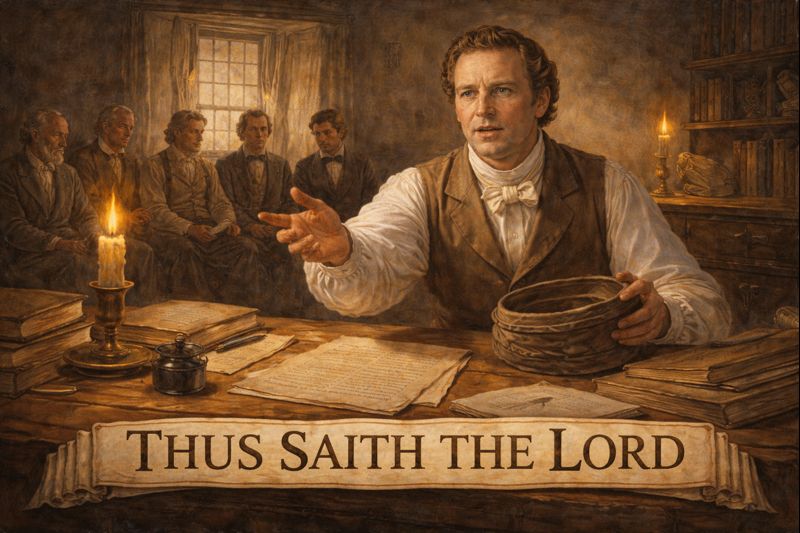
Why Later Prophets Stopped Using “Thus Saith the Lord”
The episode then examines how prophetic language evolved after Joseph Smith’s death. In the 19th century, prophets and apostles rarely introduced revelation with “thus saith the Lord.” Brigham Young taught that faithful Saints would recognize divine guidance through the Spirit without formal phrasing. Daniel H. Wells and Wilford Woodruff likewise emphasized that revelation often comes through prophetic teaching rather than dictated language, and that inspired instruction remains binding even without ceremonial wording.
Historical Debates Over Doctrine and Revelation
During the controversy surrounding the 1890 Manifesto, some Latter-day Saints opposed the revelation because it did not begin with “thus saith the Lord.” Wilford Woodruff responded that revelation had indeed guided the decision and that prophetic authority does not require a specific verbal formula. The Saints were to recognize revelation not merely by wording but through spiritual confirmation and the consistent prophetic order established since Joseph Smith’s day. This episode demonstrates that the Restoration has always relied on living prophetic guidance—regardless of whether the revelation is introduced with the language of ancient Hebrew prophets.