
Context of the Questions
Two listeners asked about the historical origins of:
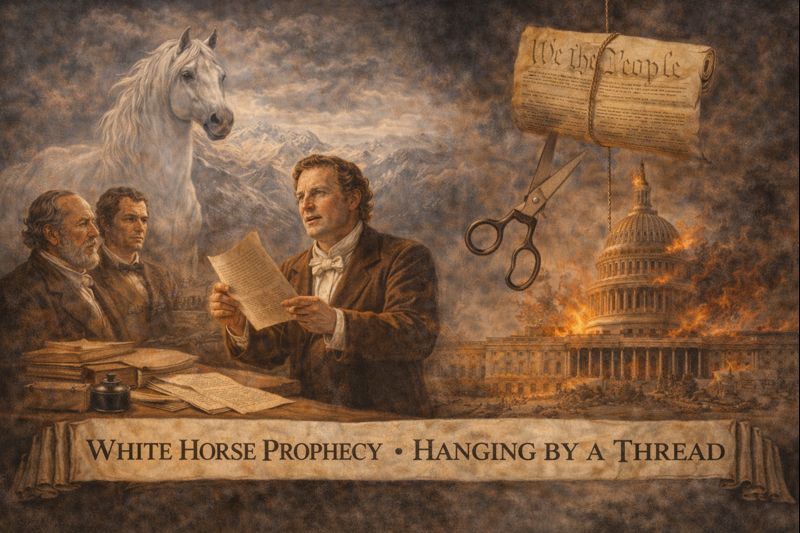
- The White Horse Prophecy
- The expression that the U.S. Constitution would “hang by a thread”
- A reported 1877 John Taylor vision about the last days (addressed in the following episode)
This episode examines the historical sources behind these ideas.
Evaluating Historical Sources
Key Principles
1. Not all sources are equal
A statement written immediately in a journal holds more weight than a memory recorded decades later.
Reminiscences can contain errors even when made by sincere individuals.
2. Time weakens accuracy
Remembering a sermon word-for-word shortly after hearing it is difficult; remembering it 50 years later is far more unreliable.
3. Mormon folklore often comes from late or second-hand accounts
Many stories commonly repeated in Latter-day Saint culture—especially dramatic prophecies—trace back to:
- Sources written long after the events
- Individuals reporting what they heard someone else say Joseph said
- Documents with no surviving original manuscript
These limitations affect the White Horse Prophecy and similar narratives.
Example of Source Reliability Issues
Famous line attributed to Joseph Smith
“If you knew what was in the celestial world, you would commit suicide to get there.”
Earliest traceable source
Appears in the journal of Charles Lowell Walker, dated August 19, 1877 — more than 33 years after Joseph’s death.
Walker reports that Wilford Woodruff, in a funeral sermon, claimed Joseph Smith once said something “like this.”
Additional points
- Does not mention the Celestial Kingdom specifically
- Refers only to “what was behind the veil”
- Is explicitly labeled “something like this,” acknowledging uncertainty
This illustrates how folklore evolves based on late, indirect reports.
Origins and Reliability of the White Horse Prophecy
The Document
The “White Horse Prophecy” is a long text attributed to Joseph Smith, describing:
- A future move to the Rocky Mountains
- A group called the “White Horse”
- Last-days turmoil and destruction in the United States
- A crisis in which the Constitution “hangs by a thread”
Problems with Authenticity
1. No contemporary record
There is no record from Joseph Smith’s lifetime of him delivering this prophecy.
Joseph’s journals and the journals of his close associates contain no mention of it.
2. First attributed source is extremely late
The earliest known written version is from the 1890s, about 50 years after Joseph’s death.
It claims to come from Edwin Rushton, who said he heard Joseph give the prophecy in 1843, but:
- No manuscript written by Rushton exists
- Surviving versions are copies of copies
3. Anachronisms inside the prophecy
It refers to the discovery of gold in California (1848–49).
If Joseph supposedly said this in 1843, such references reveal later insertion or reconstruction.
4. Disavowal by Church leaders
Joseph F. Smith (General Conference, October 1918)
Called the White Horse Prophecy:
- “Ridiculous”
- “Trash”
- “Never spoken by the Prophet in the manner in which it is published”
- Assembled by individuals years after Joseph’s death
Joseph Fielding Smith
Also condemned purported revelations not coming through proper channels.
Conclusion
Historians and Church leaders agree:
- The White Horse Prophecy is not authentic
- It is late, unreliable, and embellished
Statements About the U.S. Constitution “Hanging by a Thread”
Authentic historically attested references
Although the White Horse Prophecy is not credible, some early sources record Joseph Smith making general statements about the future of the Constitution.
James Burgess account
A late 1840s journal entry states that Joseph said:
- The Constitution would one day “hang by a brittle thread”
- The Latter-day Saints would step forth and save it
Reliability considerations
- Still a reminiscence, not a contemporaneous record
- But much closer to Joseph’s lifetime than the White Horse Prophecy
- Content matches Joseph’s themes on government corruption and constitutional protection
Later Leaders Echo Similar Themes
John Taylor (1879)
Stated that:
- The nation would experience upheaval
- The Saints would uphold constitutional principles
- People would flee to Zion seeking safety
These are interpretations, not explicit fulfillments.
Historical Context
Latter-day Saints in the 1800s repeatedly interpreted national crises as signs of:
- Decline of U.S. institutions
- Fulfillment of prophecy
- Approaching last days
Examples include:
- Civil War
- World War I
- Spanish Flu Pandemic
- World War II
Each generation believed the end was imminent.
Key Takeaways
White Horse Prophecy
- Not authentic
- Not supported by contemporary evidence
- Explicitly rejected by Church presidents
Constitution “Hanging by a Thread”
- May reflect real statements by Joseph Smith
- Earliest sources are secondary reminiscences
Interpretation
- Modern prophecy interpretation belongs to living prophets
- Historians emphasize original context, not present-day proof-texting
White Horse Prophecy (Part 2)
Background: John Taylor “Vision” Circulating Online
A vision attributed to John Taylor (1877) circulates online, often connected to:
- Pandemics
- Collapse of society
- Signs of the times
Many online versions claim it comes from Wilford Woodruff’s journal.
Basic Historical Method Applied to the “John Taylor Vision”
Does the text match Woodruff’s journal?
Online versions claim direct quotes, but comparisons reveal:
- Changed wording
- Missing sentences
- Added language
Example: Opening paragraph differences
Online version:
“I retired to bed… reading a revelation contained in the Doctrine and Covenants…”
Actual journal:
“I went to bed… reading the revelations in the French language…”
Sleep and consciousness description differences
Online versions:
- “dreamy feeling”
- “partially unconscious”
Journal version:
- “strange stupor”
- “not asleep nor awake”
- “far away dreamy feeling”
Online versions compress and simplify the account, removing qualifiers.
Attribution Issues
Wilford Woodruff copied a “very strange vision” into his journal (June 1878):
- He does not identify John Taylor as the author
- The vision is treated as a copied document, not a revelation
Conclusion
The vision is:
- Secondary
- Of uncertain authorship
- Not canonized
- Not official doctrine
Content Differences in the “Plague and Desolation” Section
Mourning in Salt Lake City
- Online: Dramatic voice speaking
- Journal: Cautious wording — “seemed,” “whatever it was”
Migration to the mountains
- Journal: Women carrying bundles, rusty rails, Taylor unaware how he travels
- Online: Simplified and dramatized
Violence in Missouri and Illinois
Both mention violence, but the journal version is more detailed and specific.
Is This Truly a John Taylor Vision?
Evidence suggests it is:
- A copied, secondary text
- Of uncertain origin
- Later attributed to Taylor
Not an authoritative revelation.
Apocryphal Sources and Secret Last-Days Knowledge
Apocalypse of Elijah
Questions about Revelation 11 and the two prophets often rely on apocryphal writings.
Latter-day Saint leaders have suggested possibilities, but:
- No official interpretation exists
- Apocryphal books are not doctrinally authoritative
Early Christian Apocrypha
Gospel of Thomas
- Sayings of Jesus
- Late, non-canonical
Gospel of Mary
- 5th century
- Gnostic theology
- Not written by Mary Magdalene
Infancy Gospels
- Late fictional stories of Jesus as a child
- Not historically reliable
Gnosticism and Its View of Christ
Gnostic beliefs include:
- Matter is evil
- Christ only appeared physical
- Salvation through secret knowledge
These contradict Latter-day Saint doctrine.
How People Misuse Apocrypha and Late Sources
Patterns include:
- Starting with a desired conclusion
- Searching for obscure texts to support it
- Proof-texting
Examples include:
- White Horse Prophecy
- John Taylor vision
- Numerology and timelines
- Non-canonical gospels
Latter-day Saint Approach to Prophecy
Principles
- We do not know the timing of the Second Coming
- Safety lies in following living prophets
- Obedience is greater than seeking secret knowledge
- Major last-days instructions come through established channels
Summary
John Taylor Plague Vision
- Secondary text
- Altered online
- Uncertain authorship
- Not doctrinal
Apocryphal Books
- Historically interesting
- Not doctrinally reliable
Latter-day Saint Perspective
- Follow historical method
- Focus on standard works and living prophets