
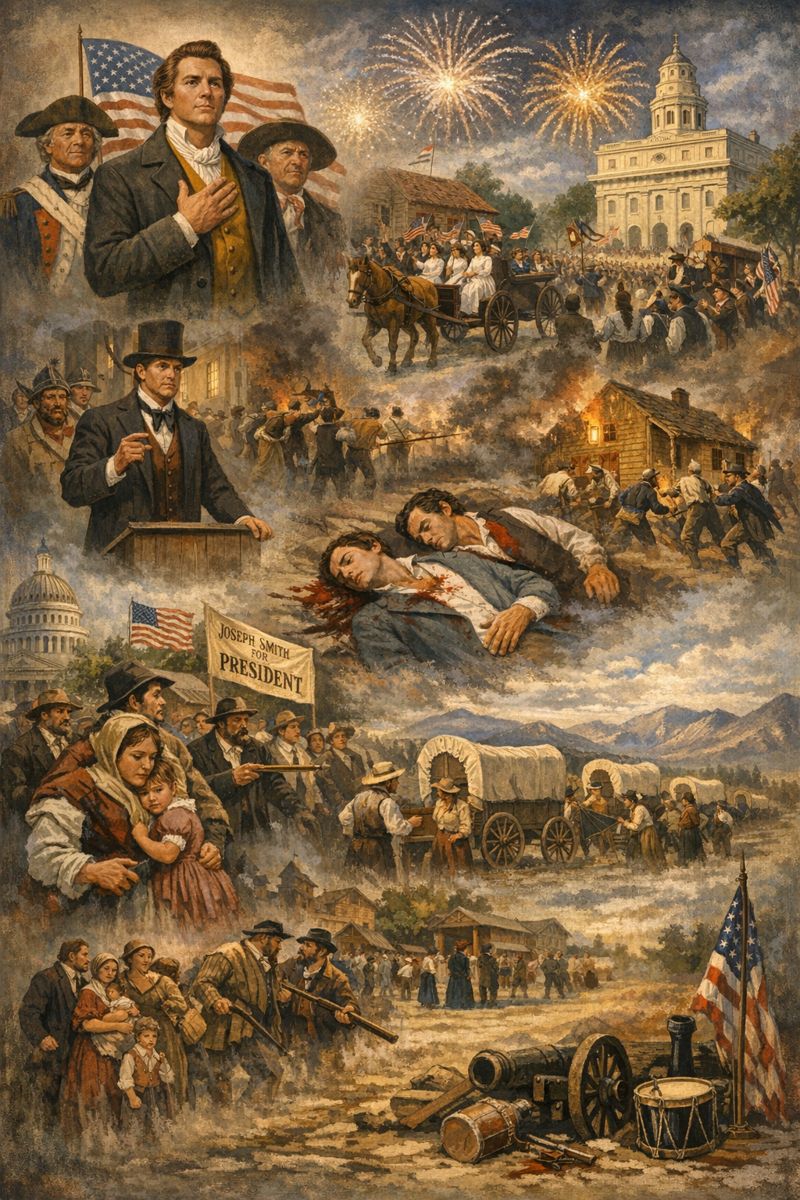
Early Latter-day Saint Patriotism
The early Saints, including Joseph Smith, viewed themselves as strongly patriotic Americans. Joseph Smith’s ancestors fought in the American Revolution, and early members saw their faith as tied to the founding principles of the United States. They believed that the Restoration was made possible by the freedoms guaranteed in the nation’s founding documents, especially religious liberty.
Celebrations of the Fourth of July were important to the Saints. In 1841, the Church held a large Independence Day celebration in Nauvoo, Illinois. Joseph Smith publicly expressed loyalty to the United States and declared that he would willingly give his life for the good of the country.
Political Challenges and Growing Disillusionment
Although the Saints believed deeply in American ideals, they repeatedly experienced political corruption and failures of justice, particularly regarding:
The expulsion from Jackson County, Missouri
The extermination order issued by Missouri Governor Lilburn Boggs
The destruction of the Saints’ property
The murders and assaults committed against them without legal consequence
The failure of courts and government leaders to intervene on their behalf
Joseph Smith repeatedly attempted legal and political appeals to obtain redress for the wrongs in Missouri, but no effective help came.
1842–1844: Shift in Attitude After Missouri
By 1842–43, following multiple crises—including large apostasies, slander campaigns, and false accusations related to the attempted assassination of Lilburn Boggs—Joseph became increasingly aware that the government was unwilling to protect the Church.
In 1844, Joseph Smith ran for president of the United States primarily to call national attention to the violations of religious liberty and the failure of state and federal governments to protect minority rights.
In his presidential platform, Joseph quoted the Declaration of Independence, emphasizing that if all men were created equal, then slavery and other injustices contradicted the nation’s founding ideals. Joseph was not rejecting the United States but urging it to rise to the standard of its own founding principles.
Plans to Leave the United States
By February 1844, Joseph recorded instructions to the Twelve to investigate potential settlement locations outside the United States, including California, Oregon, or Mexico. The intent was to find a place where the Saints could live in peace under their own laws.
This planning continued after Joseph’s death. In early 1845:
Illinois revoked Nauvoo’s city charter.
No legal protections remained for Latter-day Saints in the state.
Violence and threats against Church members increased.
Church leaders concluded that they needed to leave the United States for their safety and survival.
Rising Violence in 1845
Sheriff Minor Deming, a non-Latter-day Saint, wrote in July 1845 that mobs in Hancock County were acting openly and without fear of legal consequences. He noted that men who had been involved in the murder of Joseph and Hyrum Smith were now working to expel the Saints entirely, and that civil authority was powerless against them.
The Fourth of July, 1845: A Silent Protest
Given the circumstances of murder, expulsion, and political abandonment, the Saints in Nauvoo made a conscious decision not to celebrate the Fourth of July in 1845. This was a symbolic act demonstrating that the nation which had promised liberty had failed to protect them.
George A. Smith recorded that the day was silent—no firing of guns, no celebrations. The Church newspaper noted that the tragedies of recent years made celebration impossible:
Expulsion from Missouri
The assassination of Joseph and Hyrum
The revocation of the Nauvoo charter
The failure of legal protection
Newspapers in surrounding states seized on the Saints’ silence and mocked them, calling them “fanatics” and criticizing their refusal to celebrate. Papers argued that if the Saints would not observe Independence Day, they must be disloyal citizens. These criticisms ignored the profound political persecution the Saints had endured.
The Nauvoo Neighbor Responds
The Nauvoo Neighbor responded by pointing out the hypocrisy: the Saints had been robbed, murdered, driven from their homes, and denied legal protection. Under such conditions, celebration of liberty would be hollow.
The editorial further noted that other minority groups in the United States likewise suffered injustice, referencing:
The lynching of a gambler in Vicksburg
The burning of a Black man in St. Louis
The massacres of Catholics and immigrants in Philadelphia
These examples were used to show that American democracy often failed minority groups, not just Latter-day Saints.
Conclusion: Why the Saints Left the United States
The events of 1844–45 convinced Church leaders that:
The United States no longer provided them legal protection
Religious freedom could not be exercised safely
Their existence in Illinois was endangered
Brigham Young and the Twelve began full preparations for the exodus west. Their silence on July 4, 1845 symbolized the painful reality that the freedoms promised by the nation’s founding documents were not being applied to them.
Despite these experiences, Latter-day Saints would later resume celebrating the Fourth of July in Utah and continued to affirm gratitude for the American constitutional system, while remembering the injustices suffered during the Church’s early years.