
Introduction
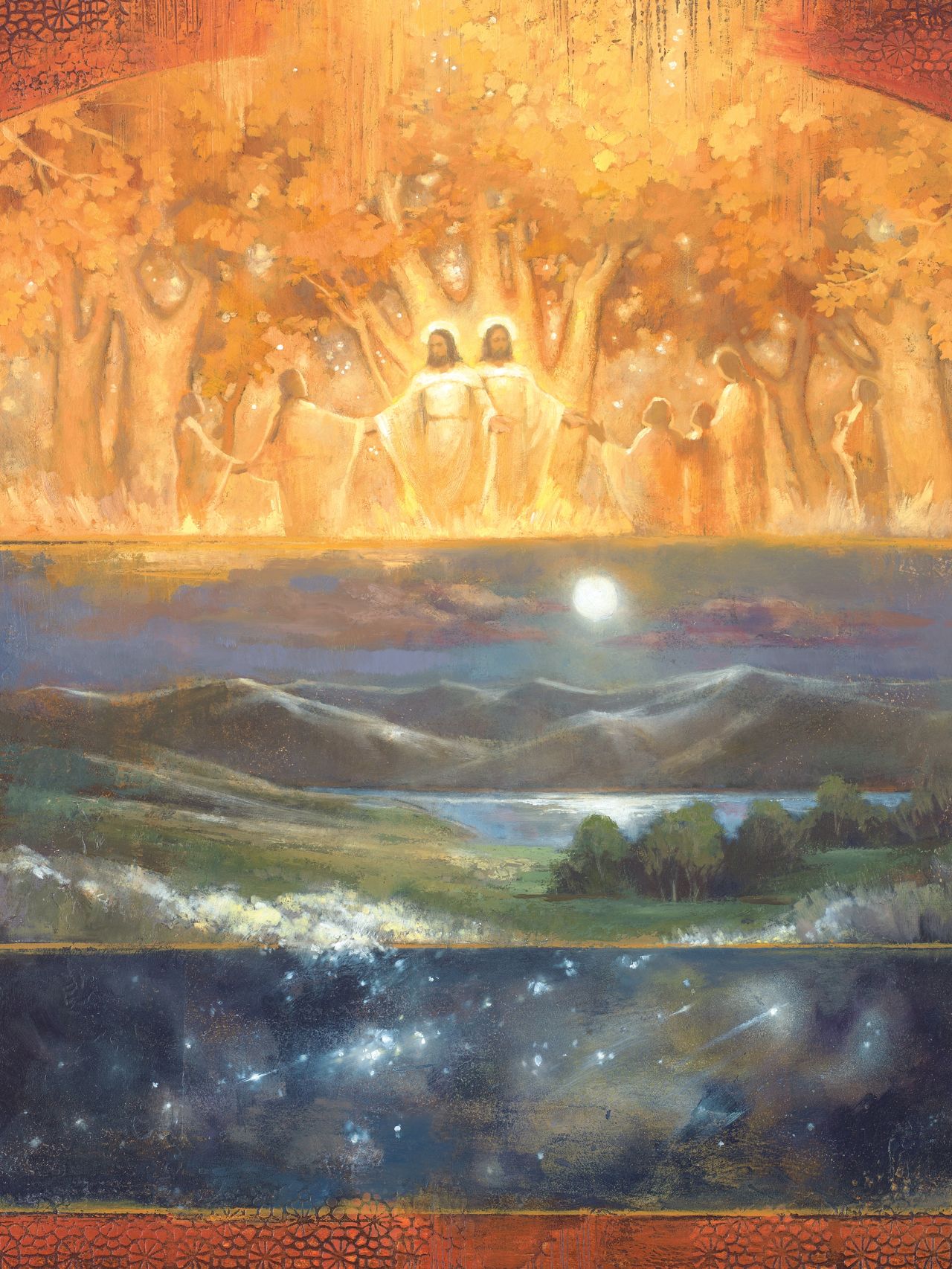
Doctrine and Covenants 76 — often referred to simply as “the Vision” by early Saints — presented a radical doctrine to the nineteenth-century Protestant world. Among its teachings are the idea of degrees of glory (celestial, terrestrial, and telestial), the rejection of an eternal hell in the classical Protestant sense, and the affirmation that Jesus Christ will save all, except the sons of perdition, from eternal suffering.
A recurring question among Church members is:
“After the Final Judgment, is there progression from one kingdom to another (for example, from the telestial to the terrestrial, and from the terrestrial to the celestial)?”
This text summarizes historical and doctrinal teachings on that topic, showing that there are apostolic statements on both sides, and that the Church has not declared a definitive official doctrine on progression between kingdoms.
The Vision (Doctrine and Covenants 76) and Salvation
In D&C 76, Joseph Smith and Sidney Rigdon receive a joint vision that describes:
- The celestial kingdom, with the exalted becoming “gods, even the sons of God.”
- The terrestrial kingdom, for the “honorable men of the earth” who were “not valiant in the testimony of Jesus.”
- The telestial kingdom, for “liars, sorcerers, adulterers, whoremongers,” and others who suffer the wrath of God in hell until Christ has “subdued all enemies” and “perfected his work.”
A radical point of this revelation is that:
- “Hell” (post-mortal suffering) is temporary for the great majority.
- Even those in the telestial kingdom inherit a glory that “surpasses all understanding,” described by Joseph in his poetic version as a “dominion of bliss.”
Joseph would later teach that:
- Jesus Christ will save all, except the sons of perdition, from eternal suffering.
- The classic Protestant doctrine of an endless, eternal hell for almost everyone does not apply in the plan revealed in D&C 76.
The Question: Is There Progression Between Kingdoms?
The specific question is:
- After a person is resurrected and judged, can they progress from one kingdom to another (for example, from the telestial to the terrestrial, from the terrestrial to the celestial)?
- Or is progression possible only within the same kingdom?
Historically, Church leaders have taught different things about this:
- Some have affirmed that there is no progression between kingdoms.
- Others have suggested there is a possibility of progress over the eternities, including between kingdoms.
- The First Presidency has stated, in a letter, that the Church has never defined an official doctrine on this point.
Teachings That Deny Progression Between Kingdoms
Bruce R. McConkie
In his BYU address “The Seven Deadly Heresies” (1980), Elder Bruce R. McConkie taught that it is a heresy to believe that:
- There is progression from one kingdom to another in the eternities, or
- That lower kingdoms will eventually arrive at the level where higher kingdoms once were.
He taught that:
- People are resurrected with different kinds of bodies:
- Celestial
- Terrestrial
- Telestial
- And some with bodies incapable of enduring any degree of glory.
- The type of resurrected body determines the glory and the kingdom received.
- There is no progression from one kingdom to another; any progression is within the sphere into which a person is resurrected.
- Viewing salvation as “eventually everyone will arrive at the celestial kingdom” would place people in a state of carnal security, encouraging sin now with the hope of guaranteed exaltation later.
Spencer W. Kimball (before becoming President of the Church)
In The Miracle of Forgiveness, then-Elder Spencer W. Kimball taught that:
- After judgment, when a person is assigned to a kingdom of glory (celestial, terrestrial, or telestial) — or to exaltation —
- They will not advance from one glory to another.
- That assignment is eternal, which is why it is so urgent to make correct decisions in this life.
These teachings have led many Latter-day Saints to conclude that, after the Final Judgment, the “line between kingdoms” is fixed.
Teachings That Suggest Possible Progression After Judgment
Several prominent leaders, including members of the First Presidency, have left open — or affirmed — the possibility of progression over the eternities.
Hyrum Smith
Hyrum Smith taught in 1843 that those in the terrestrial kingdom could:
- Advance to the celestial, or
- Recede to the telestial,
Using the moon (which waxes and wanes) as the symbol of the terrestrial kingdom. This suggests some form of mobility between kingdoms.
Brigham Young
Brigham Young taught that:
- Only those crowned as gods will inherit this earth when it becomes celestial.
- Others will inherit kingdoms according to the law they obeyed.
He also stated that:
- These others could eventually prove themselves worthy
- And advance to a celestial kingdom, though very slowly.
He emphasized God’s mercy, teaching that all, except the sons of perdition, will be saved from eternal hell, though in different degrees of glory.
Wilford Woodruff
Wilford Woodruff taught that:
- Revelation comes according to capacity.
- If progression were ever to stop, it would cast a “gloom” over any intelligent mind.
- God Himself continues to progress “worlds without end.”
- Humanity is in a school of experience, suggesting ongoing progression.
J. Reuben Clark (First Presidency)
President J. Reuben Clark stated (Church News, April 23, 1960):
- Eternal progress is not sealed solely by what we do here.
- God will save all His children that He can.
- Over eternal ages, even the unrighteous may rise to the same destinies as the righteous if they respond to light, truth, and repentance.
Orson F. Whitney
In April 1929 general conference, Elder Orson F. Whitney taught that:
- Faithful parents’ sealings would reach even wayward children.
- They are not utterly lost.
- The Good Shepherd will seek His sheep.
- “Sooner or later,” divine providence will draw them back.
- Suffering that leads back to God is not in vain.
This teaching was connected to promises given by Joseph Smith to Newel K. Whitney regarding priesthood lineage.
Official Position: No Definitive Doctrine on Progression Between Kingdoms
In 1952, Joseph L. Anderson, secretary to the First Presidency, stated that:
- The Church has never announced a definite doctrine on progression between kingdoms.
- Some leaders believe progression is possible.
- Others believe it is not.
- The Church has not defined this as revealed doctrine.
Therefore:
- It is not official doctrine that there is progression between kingdoms.
- It is not official doctrine that there is not progression between kingdoms.
- Faithful leaders have held views on both sides.
Baptism, Salvation, and Apparent Scriptural Tension
Scriptures That Require Baptism for Salvation
“He that believeth and is baptized shall be saved; but he that believeth not shall be damned.”
“And whoso believeth in me, and is baptized, the same shall be saved…”
From these, the doctrine is clear:
- Baptism is essential for exaltation.
Scriptures That Promise Salvation to the Unbaptized
Those who died in ignorance “shall have part in the first resurrection.”
The heathen nations will also have part in the first resurrection.
This creates tension between necessity of baptism and salvation of the unbaptized.
Alvin Smith and the Kirtland Temple Vision (D&C 137)
Joseph Smith saw his brother Alvin in the celestial kingdom, despite his lack of baptism.
The Lord declared:
- All who would have accepted the gospel will inherit celestial glory.
The mechanism was not yet revealed.
Baptism for the Dead: Resolution
D&C 127–128 revealed vicarious baptism:
- Baptism remains necessary.
- Everyone will have the opportunity.
This pattern teaches patience with unresolved doctrines.
Mercy, Agency, and the Character of God
Revelation affirms that:
- All chose Christ premortally.
- All will receive a glory.
- Post-mortal suffering is real but temporary for most.
- Christ saves all except the sons of perdition.
- The kingdoms of glory are not eternal hells.
- God is more merciful than we comprehend.
- Exaltation requires ordinances and covenants.
- Revelation continues.
Conclusion
The question of progression between kingdoms has no definitive official answer.
- Faithful leaders have taught both positions.
- The First Presidency has confirmed no official doctrine exists.
The faithful response is to:
- Accept what has been revealed.
- Avoid doctrinal extremism.
- Trust in God’s mercy and justice.
- Focus on covenants, obedience, love, and discipleship.