
Elijah’s Central Role in Jewish Passover Tradition
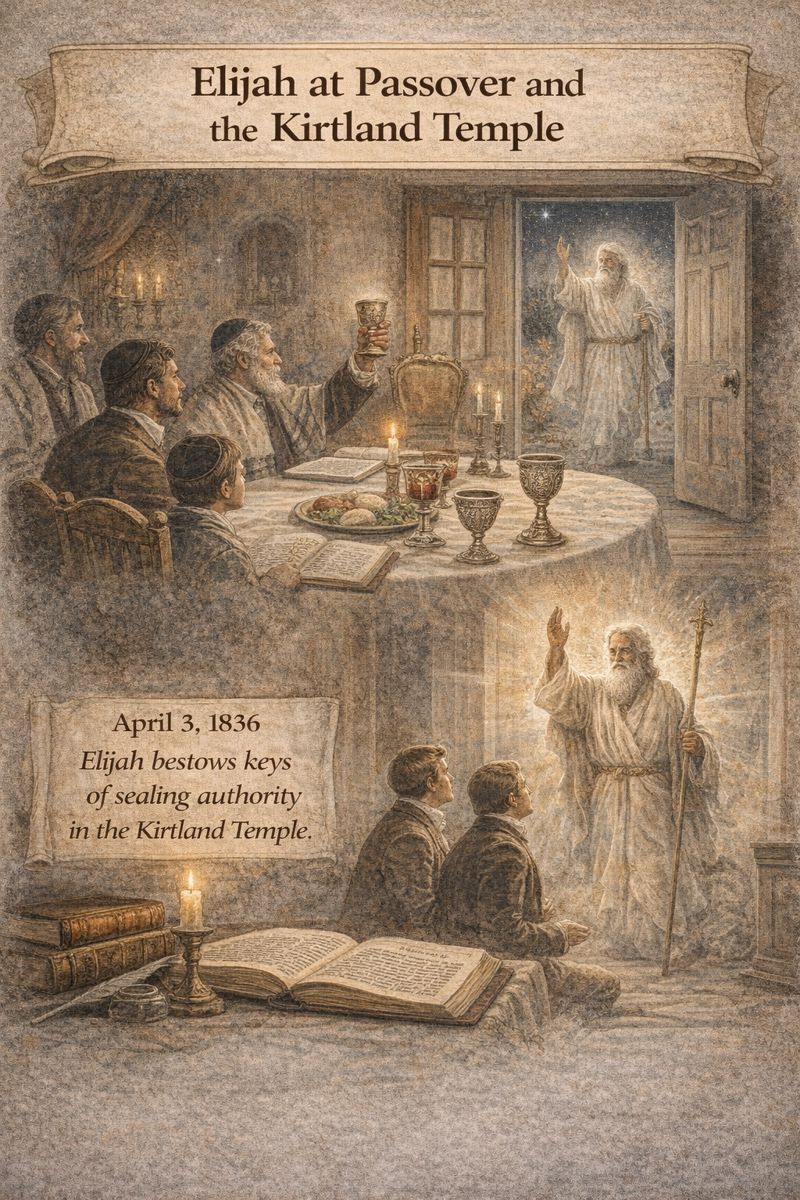
For centuries, Jewish families have set a special place at the Passover table for the prophet Elijah. In every traditional Seder, a fifth cup of wine—the Cup of Elijah—is poured but not consumed, symbolizing anticipation for his return. Doors are opened, seats remain empty, and prayers are recited in hope that Elijah will appear, for Jewish belief holds that he precedes the coming of the Messiah. These rituals are rooted in Malachi’s prophecy that Elijah would return “before the great and dreadful day of the Lord,” making him a figure of expectation woven deeply into Jewish identity.
Elijah’s Appearance in the Kirtland Temple
Within Latter-day Saint history, the account of Elijah’s return is recorded under the date April 3, 1836—a date that fell during Passover that year. It appears in Joseph Smith’s 1835–1836 journal in the handwriting of Warren Cowdery, one of Joseph’s scribes. Because Warren Cowdery left the Church by 1838, the record must have been inscribed before his departure.
This vision—later canonized as Doctrine and Covenants 110 in 1876—describes Elijah appearing in the Kirtland Temple and bestowing sealing authority on Joseph Smith and Oliver Cowdery. Though canonized decades later, the event itself belongs firmly to the spring of 1836, confirming its authenticity as an early historical entry rather than a retrospective invention.
Elijah in Christian and Jewish Expectation
Long before the Restoration, early Christian writings portrayed Elijah as a herald of the Messiah, echoing Jewish tradition. Jewish texts, Christian commentaries, and later medieval sources all emphasize Elijah as the figure who prepares the way for redemption. Thus, the connection between Passover symbolism and the Kirtland Temple vision finds deep resonance in the shared religious heritage surrounding this prophetic figure.
The Symbolism of Passover’s Five Cups
Passover wine tradition includes four cups representing divine promises from Exodus—God’s commitment to bring Israel out, deliver them, redeem them, and take them as His people. A fifth cup, the Cup of Elijah, stands apart. It is poured but remains untouched, waiting for the day Elijah returns to announce redemption’s ultimate fulfillment. In the Latter-day Saint context, Elijah’s appearance in the Kirtland Temple becomes a striking fulfillment of the hope embodied in that fifth cup.
Record-Keeping and the Gradual Canonization of Revelation
The episode also discusses how early Latter-day Saint revelations were preserved. Many visions, including the Elijah account, were recorded in Joseph Smith’s journals rather than immediately published. Canonization was a gradual process, shaped by available manuscripts and evolving organizational needs. Doctrine and Covenants 110 was added in 1876; Doctrine and Covenants 137, though revealed in 1836, entered the canon only in 1981. Such developments illustrate how scripture in the Restoration was gathered, refined, and organized over time.
Names, Families, and Cultural Patterns
In the broader 19th-century American world, it was common for families to name children directly after parents. Early Latter-day Saint families mirrored this pattern: Lucy Mack Smith and her daughter Lucy, Lucy Harris and her daughter Lucy, and the Woodruff family all followed such naming conventions. These customs appear repeatedly in journals, letters, and genealogical records from the era.
Dating Early Revelations and the Emergence of the Book of Mormon Title
The episode notes that some Doctrine and Covenants dates were corrected as additional manuscripts surfaced, including a major correction to the date of Doctrine and Covenants 19, now placed in summer 1829. Before the title page of the Book of Mormon was translated, early Saints referred to the record simply as “the record,” “the plates,” or “the record of the Nephites.” The first clear evidence of the name “Book of Mormon” appears in revelations from 1829.
Joseph Smith’s Liberty Jail Letter and Early Christian Doctrine
Joseph Smith’s letter from Liberty Jail, dated April 4, 1839, remains one of the most personal historical documents from his imprisonment, detailing his suffering and his hope.
The episode concludes by highlighting an important historical contrast: after the Protestant Reformation, many theologians claimed that a “true church” survived through isolated individuals who preserved belief in grace alone. Yet historically, early Christian writings overwhelmingly describe a faith that included ordinances, sacraments, works of discipleship, and ecclesiastical authority. Even Augustine—famous for his teachings on grace—affirmed the necessity of sacraments and church structure. The historical record simply does not support a continuous underground lineage of purely grace-alone believers.
Listen to the full podcast here:
Season 5, Episode 15 – Guess Who’s Coming to Dinner? It’s Elijah