
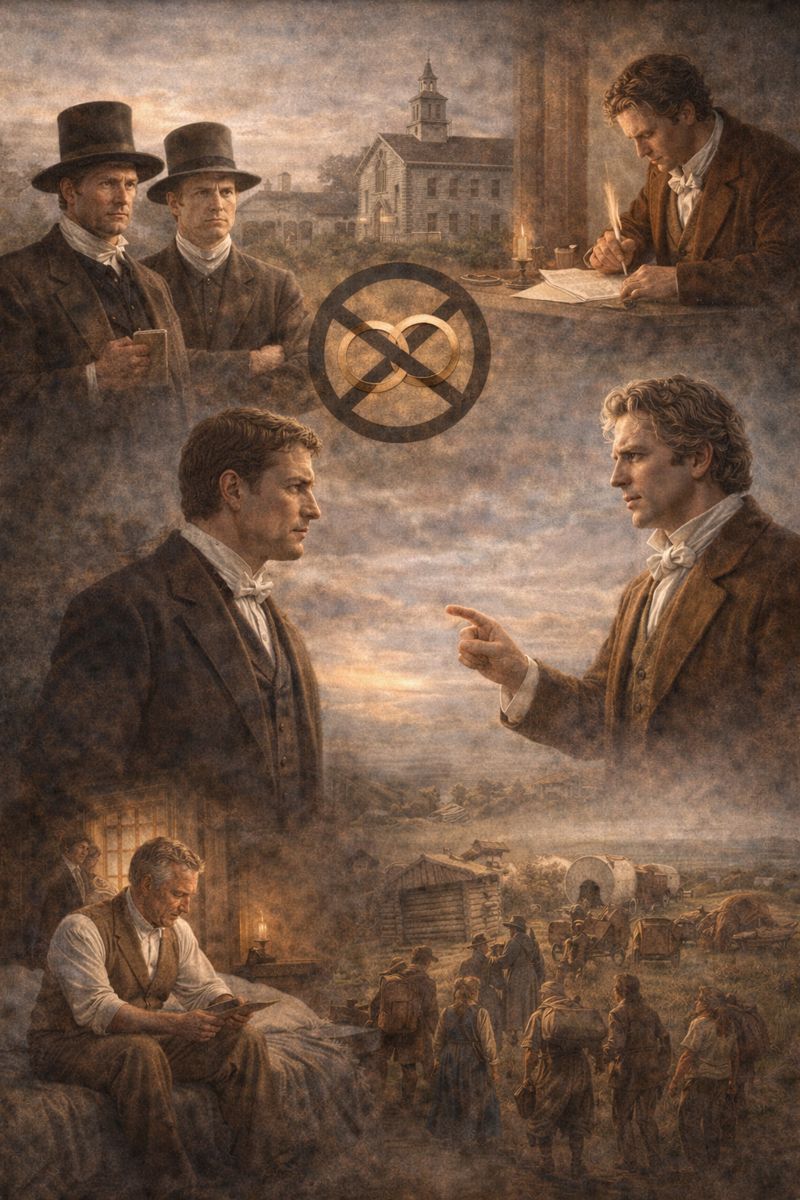
Faith Crisis
The Shaker Mission and Doctrinal Conflict in Early 1831
In the early months of 1831, the Latter-day Saints who had gathered to Ohio encountered the nearby Shaker community, whose strict celibacy, communal life, and unusual Christology set them apart from mainstream Christianity. The Shakers believed that Christ’s “Second Appearing” had already occurred in the person of Ann Lee, and they viewed marriage itself as a lower, earthly state incompatible with holiness. Thus, when Latter-day Saint missionaries arrived—men who were openly married—the Shakers rejected their message before hearing its details, seeing marriage as evidence of spiritual inferiority.
Joseph Smith received a revelation directed to this mission, now known as Doctrine and Covenants 49, correcting Shaker beliefs regarding the nature of Christ’s return, the necessity of water baptism, the divine institution of marriage, and the proper use of foods, including meat. Yet the Shakers refused the revelation. The encounter ended without a single conversion and left behind an atmosphere of doctrinal tension.
Leman Copley’s Reversal and the Crisis in Thompson, Ohio
One of the missionaries, Leman Copley, had been a Shaker before joining the Church. Though baptized, he retained elements of Shaker belief. He owned a large farm in Thompson, Ohio, and had generously offered it to the Colesville Saints—a group of faithful families from New York who had already abandoned their homes once due to persecution and had traveled to Ohio in obedience to the command to gather.
In a very short time, the Colesville Saints built cabins, planted fields, fenced property, and established a functioning settlement on Copley’s land. But after the Shakers rejected the revelation, Copley returned to visit them and soon reversed his commitment to the Church. Under renewed Shaker influence, he withdrew his support completely and ordered the Colesville Saints off his land.
Although he had consecrated the land, he had never legally transferred ownership; the Saints had no legal protection. Copley even demanded that they pay “damages” for improvements they themselves had made. What little they possessed had already been sacrificed once; now they were expelled again, forced to leave all their labor and property behind.
The Command to Journey West: Doctrine and Covenants 54
The distressed Colesville Saints appealed to Joseph Smith for direction. In response came Doctrine and Covenants 54, directing them to abandon Thompson and travel west to Missouri—over one thousand miles away. This command required the Saints to uproot themselves for the second time in the same year, after the exhausting migration from New York to Ohio.
Joseph Knight Jr. recorded that the Colesville Saints obeyed without hesitation, though they felt deep discouragement. They left behind their newly built homes and their harvested fields and set out on another long and uncertain journey. Yet the revelation carried a promise of hope:
“Be patient in tribulation until I come; and behold, I come quickly, and my reward is with me.”
These words acknowledged their suffering and affirmed that their repeated sacrifices were seen by God, even when their earthly circumstances were unstable.
The Larger Historical Context of Shaker Belief and Social Practice
The Shakers remained one of the most distinctive religious movements in early America. Their strict celibacy prevented demographic growth, meaning they survived only through conversion and through raising outsider children—many of whom were placed in Shaker villages before formal adoption laws existed. Their theology dismissed marriage, rejected outward ordinances such as baptism, and reinterpreted Christ’s mission in a radically symbolic way, believing Ann Lee to embody His return.
By the late twentieth century, the Shaker communities had nearly disappeared, dwindling to only two members in Sabbathday Lake, Maine. Their decline stands in contrast to the rapidly expanding Latter-day Saint movement, whose doctrine on family, ordinances, and Christ’s literal return differed sharply from Shaker theology.
The Colesville Saints and the Pattern of Early Latter-day Saint Migration
The story of the Colesville Saints illustrates a recurring pattern in early Church history: repeated sacrifice, displacement, and unwavering obedience. From Colesville, New York, they moved to Ohio in 1831; from Ohio they were commanded to go to Missouri. Their faithfulness amid instability became a defining example for later Latter-day Saint communities who would themselves face expulsion, migration, and rebuilding. Their journey reflected a larger theme of the Restoration era—faith forged through hardship.
Listen to the full podcast here:
Season 5 Episode 23 – Faith Crisis