
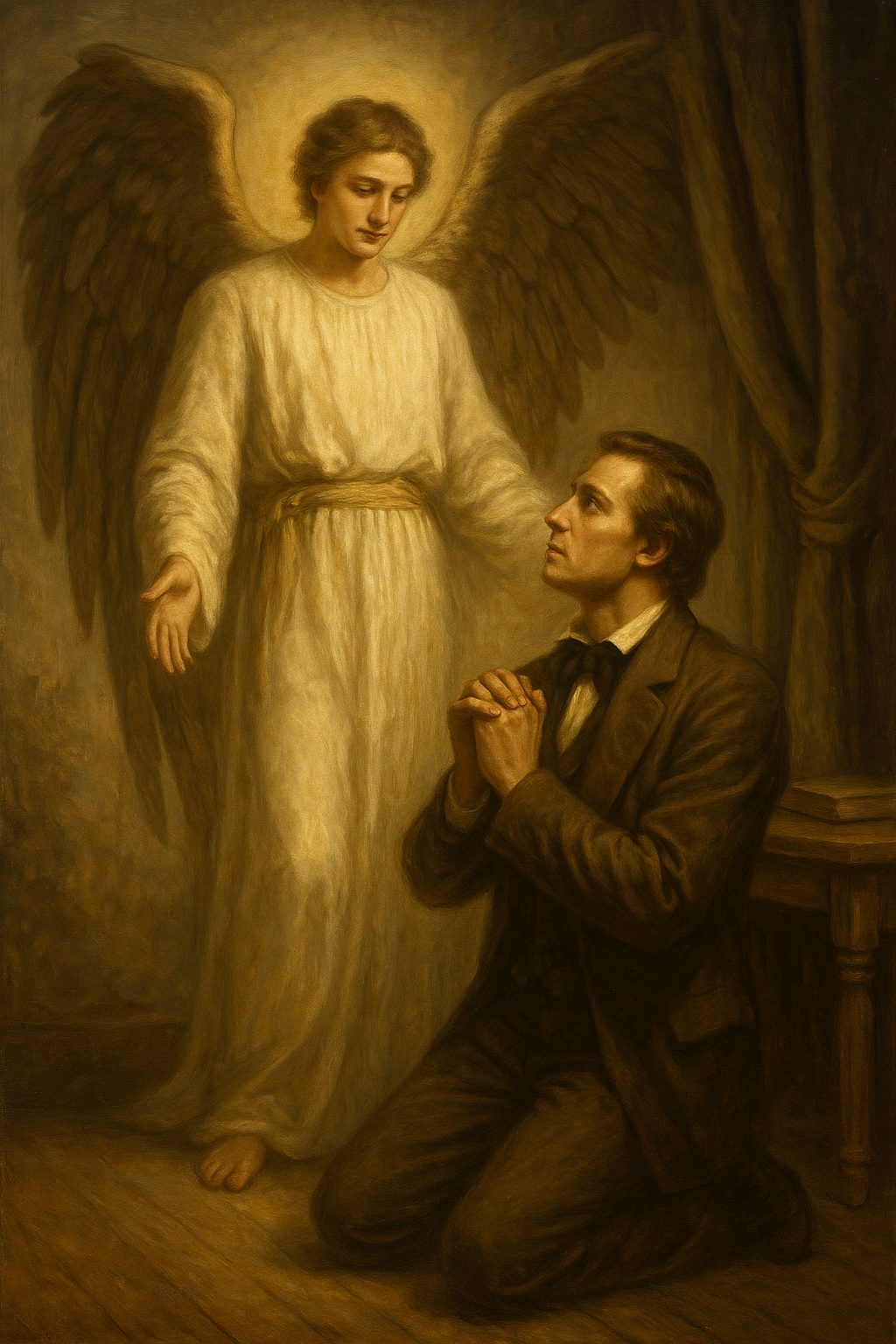
Angels in Early Christianity and Early Latter-day Saint History
Latter-day Saint theology contains ideas that differ significantly from mainstream Christian traditions, including doctrines such as a pre-mortal existence and the nature of angels. In broader Christian history, angels have traditionally been understood as beings created by God out of nothing (creatio ex nihilo). They are not considered to be deceased humans, but rather a distinct order of created beings that existed before humankind. In historic Christian theology, angels are depicted as non-human, sometimes with multiple wings or faces as described in biblical texts such as Isaiah, Ezekiel, and Revelation.
In contrast, early Latter-day Saint theology—based on Joseph Smith’s teachings—presents angels as humans in another stage of existence. According to this view, angels may be:
- Spirits who have not yet received a body
- Spirits who once had a body and are currently disembodied
- Resurrected beings with perfected bodies
Joseph Smith taught that beings who minister to this earth come from this earth and that no angels minister here except those who “belong or have belonged to it.” Early Latter-day Saint history heavily involves visitations from angels understood in this sense, such as Moroni, John the Baptist, Peter, James, John, and Michael (Adam), who provide instruction or priesthood authority.
Joseph Smith’s Angelology in Historical Sources
Doctrine and Covenants 129 (1843) distinguishes two classes of heavenly beings:
- Resurrected personages with bodies of flesh and bone
- Spirits of just men made perfect, not yet resurrected
This section outlines how early Saints could distinguish true heavenly messengers from deceptive appearances.
Teachings from Joseph Smith’s Sermons
In Joseph Smith’s historical sermons:
- He explained the difference between an angel (a resurrected or translated person) and a ministering spirit (a righteous disembodied spirit).
- He taught that Jesus ministered as a spirit to those in prison between His death and resurrection and ministered as an angel after His resurrection.
- He described a chain of authority from Adam forward, delivered through angelic ministrations.
- He recorded an event where Michael the Archangel exposed a deceptive appearance of Satan on the banks of the Susquehanna River, likely in 1828–1829.
In Doctrine and Covenants 130, Joseph Smith stated that angels who minister to this earth either currently belong to it or lived on it previously.
Historical Christian vs. Latter-day Saint Interpretations
Early Christians viewed Satan (Lucifer) as a fallen angel—one of God’s created beings who rebelled. In Latter-day Saint history, the “war in heaven” described in scripture is interpreted as a rebellion of Heavenly Father’s premortal spirit children, not of a different species of being. Thus, concepts such as the “third part” who followed Lucifer are understood differently than in traditional Christianity.
During political debates in the early 21st century, the historical theological distinction sometimes became a point of public discussion, such as claims that Latter-day Saints believe Jesus and Satan are “brothers,” which derive from Latter-day Saint teachings that all premortal spirits were children of God, including Lucifer.
Historical Development of Angel Imagery in Early Christianity
Scholarly research on early Christian iconography, including a study by Dr. Therese Martin (“The Development of Winged Angels in Early Christian Art,” 2000), shows that:
- The oldest surviving images of angels date from the late 3rd to early 4th century in the Roman catacombs.
- Early Christian angels appeared identical to men—with no wings—and were distinguishable only through context or symbolism.
- Wings became standard in Christian art during the 4th century, after Christianity’s legalization and eventual adoption within the Roman Empire.
- The addition of wings drew from classical (Greco-Roman) imagery symbolizing divine power, especially recognizable to converts accustomed to imperial and mythological iconography.
Thus, the depiction of angels with wings is a later artistic development, not present in the earliest Christian imagery.
Angels in Early Latter-day Saint Historical Accounts
Early Latter-day Saint history contains many accounts of angels ministering:
- Moroni appearing to Joseph Smith beginning in 1823.
- John the Baptist conferring the Aaronic Priesthood in 1829.
- Peter, James, and John conferring the Melchizedek Priesthood.
- Moses, Elias, and Elijah restoring additional keys in 1836 at the Kirtland Temple.
- Michael (Adam) and other angelic messengers involved in historical events described in Joseph Smith’s writings.
These ministering figures were understood as resurrected or disembodied humans who once lived on earth, consistent with Joseph Smith’s angelology.
Historical Latter-day Saint Views on the Spirit World
Early church leaders such as Brigham Young taught that the spirit world surrounds the living and that ministering beings operate in varying states before and after resurrection. These teachings formed part of early Latter-day Saint historical thought regarding angels, spirits, and the afterlife.