
Introduction: The Question of Speaking in Tongues in Early Latter-day Saint History
This episode responds to a listener’s inquiry about the practice of speaking in tongues in the early Church of Jesus Christ of Latter-day Saints. The listener encountered another podcast that claimed early Saints—including Joseph Smith and Brigham Young—spoke in tongues in a manner similar to what is seen in modern Pentecostal Christianity. The question is whether these descriptions are historically accurate and how early Latter-day Saint glossolalia compares to contemporary Pentecostal practice. Speaking in tongues is rooted deeply in the Restoration’s belief that the gifts of the Spirit described in the New Testament would return, and it therefore occupies an important place in early Church records.
Scriptural Foundation for the Gift of Tongues
The scriptural basis for this gift begins with the Articles of Faith, which affirm that the Church believes in the same spiritual manifestations present in the ancient Church, including the gifts of tongues and the interpretation of tongues. Doctrine and Covenants 46 likewise states that speaking in tongues and interpreting tongues are legitimate spiritual gifts. Because the Restoration promised the return of New Testament patterns, early Saints naturally expected that this gift would reappear among them. The expectation set by scripture led directly to early enthusiasm surrounding glossolalia in the Church’s earliest years.
Early Manifestations of Tongues in Kirtland, 1830–1831
As missionary efforts expanded into Ohio in 1830 and 1831, new converts began expressing spiritual manifestations that sometimes included dramatic vocal patterns. Reports from this period describe individuals speaking in unknown languages and sometimes engaging in behavior that Joseph Smith would later identify as false or excessive spiritual expression. These meetings occasionally became disorderly, prompting Joseph Smith to teach principles to regulate and guide spiritual gifts. These moments illustrate both the vibrancy of early spiritual enthusiasm and the need for prophetic instruction as the Church grew.
Joseph Smith’s First Recorded Encounter with Brigham Young Speaking in Tongues
The first historical instance of Joseph Smith personally encountering the gift of tongues comes from November 1832, when Brigham Young visited Joseph in Kirtland. During that visit, Brigham Young and John P. Greene spoke in an unknown tongue, and Joseph Smith himself received the gift during the meeting. Joseph stated that Brigham’s expression approximated the “Adamic language,” a concept connected to a pure or primordial language spoken before the confounding of tongues at the Tower of Babel. This moment is one of the earliest and clearest documented expressions of glossolalia in the restored Church.
Tongues in Sacred Worship Gatherings, 1833
Records from January 1833 describe multiple meetings in which Joseph Smith and other Church members spoke in unknown tongues. These gatherings included both men and women receiving the gift of tongues, as well as singing, praying, and exhorting in tongues. In some instances, the washing of feet ordinance accompanied these spiritual manifestations. These early accounts show that the Saints accepted glossolalia as a legitimate and sacred expression within their worship services during this period.
The Kirtland Temple Pentecost, 1836
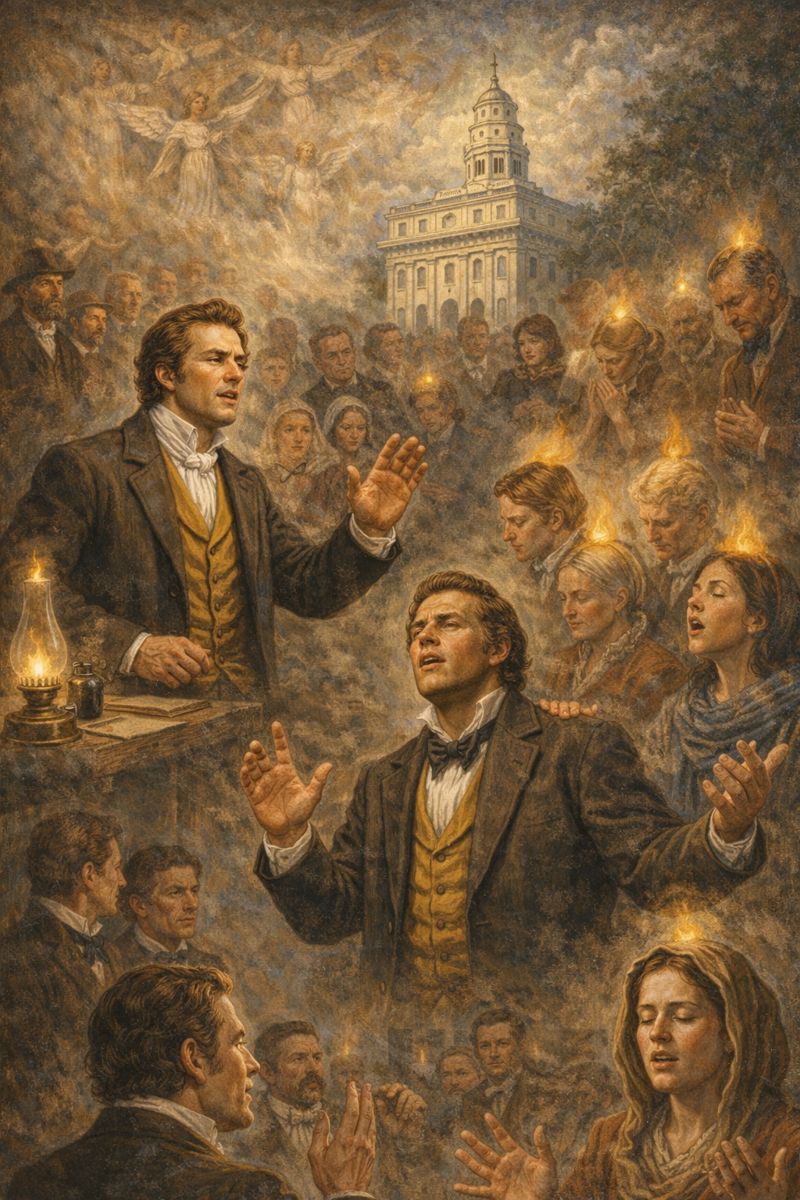
During the period of the Kirtland Temple dedication in 1836, many participants recorded experiences that echoed the New Testament book of Acts. People spoke in tongues, while others interpreted what was spoken. Spiritual outpourings during these meetings included visions, angelic appearances, and a sense that the Saints were experiencing their own Pentecost. The strong manifestation of glossolalia at this historic moment underscores the early Saints’ belief that the Restoration was bringing back the same spiritual gifts found in the New Testament Church.
Joseph Smith’s Regulation of the Gift of Tongues
As the Church expanded, Joseph Smith began teaching that the gift of tongues, though real, required caution and order. He repeatedly emphasized that Satan could counterfeit spiritual gifts, including tongues, and therefore enthusiastic spiritual displays were not automatically signs of divine approval. He taught that tongues should not be regarded as proof of doctrinal truth and that their use in public meetings required interpretation. Joseph clarified that no one should speak in tongues during a public gathering unless an interpreter was present.
He further instructed that no doctrine should ever be taught in tongues and that only those presiding should permit the gift’s use in meetings. In 1839, Joseph elaborated that the primary purpose of the gift of tongues was missionary work, especially preaching to those who spoke languages unknown to the missionary. This teaching re-centered glossolalia away from ecstatic worship and toward practical missionary communication.
Joseph Smith’s Counsel to the Relief Society, 1842
Joseph Smith also addressed the Relief Society about the gift of tongues, explaining that while speaking in tongues could be a source of personal comfort or spiritual edification, it should not be used to declare doctrine. He warned that excessive focus on the gift made individuals vulnerable to deception, as evil spirits could mimic the gift. His remarks to the Relief Society further refined the proper use of tongues by distinguishing between legitimate spiritual comfort and the potential for misuse.
Why Glossolalia Declined in Later Latter-day Saint Worship
Glossolalia was common in the earliest years of the Church, but its frequency gradually declined. This decline was not due to a rejection of the gift itself but rather to Joseph Smith’s increasingly specific teachings about its proper use. As Church organization became more structured, and as Joseph emphasized that tongues were not central to worship or doctrinal instruction, dramatic manifestations became less common. Glossolalia continued as a legitimate spiritual gift, but it was no longer a frequent or prominent feature of Latter-day Saint worship. The Saints continued to believe in the gift, but they followed Joseph’s instructions that it should be used sparingly, under priesthood direction, and primarily for missionary purposes rather than public display.
Comparing Early Latter-day Saint Glossolalia with Modern Pentecostal Practice
Although early Latter-day Saint experiences sometimes resembled Pentecostal glossolalia, important differences exist. Early Saints often spoke in tongues in a controlled manner, with interpretation required, and always under priesthood authority. The practice was not associated with frenzied behavior or loss of bodily control, and Joseph Smith insisted that tongues should never be used to teach doctrine. Over time, the Saints de-emphasized the practice. In contrast, modern Pentecostal glossolalia is often characterized by emotional ecstasy, personal sanctification, spontaneous vocal expression, and sometimes by a belief that tongues are a sign of the Holy Spirit’s immediate presence. While both traditions share the belief in a spiritual gift of tongues, they differ in purpose, theology, regulation, and expression.
Conclusion: What History Actually Shows
Historical records clearly demonstrate that early Latter-day Saints—including Joseph Smith and Brigham Young—experienced speaking in tongues. These manifestations were meaningful to the Saints and were seen as evidence of the Restoration’s spiritual power. At the same time, Joseph Smith consistently regulated how the gift should be used, emphasizing interpretation, order, and doctrinal safety. He taught that the primary purpose of the gift was missionary communication rather than ecstatic worship. Over time, this prophetic guidance shaped the Church’s culture, leading to a natural decline in the public practice of glossolalia. The early Saints’ experience with tongues therefore reflects both spiritual enthusiasm and prophetic refinement, and differs significantly from later Pentecostal models while maintaining a firm scriptural foundation.