
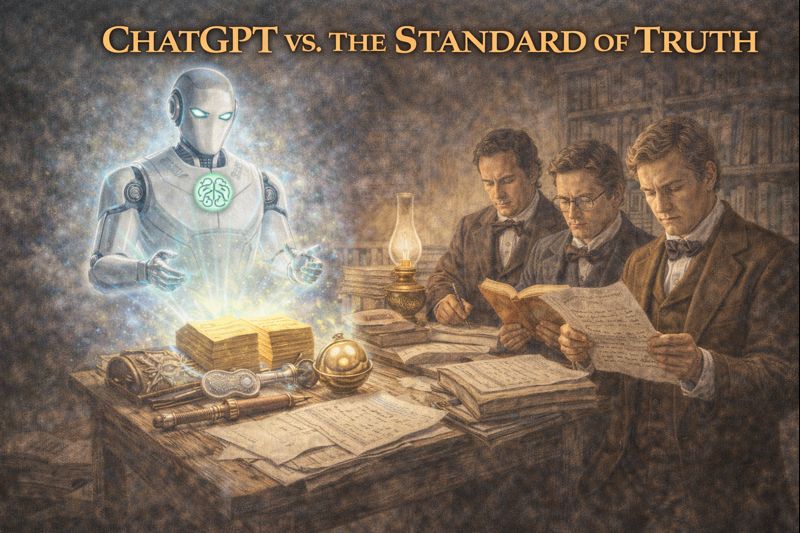
Historical Study and the Use of Primary Latter-day Saint Sources
This episode begins by exploring what it means to study early Latter-day Saint history responsibly. The hosts emphasize that understanding Joseph Smith and the Restoration requires direct, careful engagement with original historical documents. These include journals written at the time events occurred, dictated manuscripts, letters, and eyewitness testimonies. To reconstruct the past accurately, historians must evaluate each source’s reliability, compare accounts, and distinguish between firsthand evidence and later hearsay.
How Historical Accuracy Is Determined
The episode underscores a growing challenge in the digital age: people often rely on non-credentialed sources, online speculation, or content produced without academic standards. Claims about Joseph Smith or early Church events must be examined using rigorous historical methodology. This includes understanding bias, chronology, context, and corroboration across multiple witnesses. Arguments that contradict overwhelming documentary evidence—and are rejected by trained historians, Latter-day Saint or not—should be treated with caution. Responsible history requires expertise, not viral claims.
Biblical and Historical Context for Polygamy
A major theme of the episode is the biblical and historical treatment of plural marriage. Contrary to modern assumptions, the Bible never condemns polygamy as a sin. Several major figures practiced plural marriage—Abraham, Jacob, Moses, and David—without divine rebuke. In some cases, the Old Testament prescribed marriage obligations that required polygamy, such as levirate marriage. While the New Testament elevates monogamy as the ideal, it never forbids plural marriage. Cultural resistance to polygamy largely emerged from Roman social norms, not from biblical doctrine. As Christianity spread through the Roman world, Roman monogamy became mistakenly equated with Christian teaching. Historically, biblical religion allowed plural marriage, while later cultural Christianity rejected it.
Joseph Smith, Plural Marriage, and the Historical Record
The podcast explains that nearly all trained historians, including non–Latter-day Saint scholars, accept that Joseph Smith both taught and practiced plural marriage. The evidence is extensive, consistent, and comes from diverse sources: journals like William Clayton’s, statements from plural wives, testimonies from men directly involved, and accounts from individuals who later left the Church but never denied Joseph’s practice. A small number of late-life statements—most notably from Emma Smith—deny Joseph’s involvement, but these are contradicted by dozens of contemporaneous sources and sometimes include inaccuracies. Historians evaluate evidence collectively, not by privileging one conflicted account over the entire documentary record. Thus, the historical consensus remains firm: Joseph Smith practiced and taught plural marriage.
The Gold Plates and the Witnesses’ Testimonies
The episode then examines the historical evidence surrounding the gold plates. Eleven official witnesses signed written testimonies describing seeing or handling the plates. Beyond these, many others lifted or felt the covered plates, and critics acknowledged that Joseph possessed a distinct physical object. The witnesses never recanted. Even during periods of estrangement from Joseph Smith or the Church, they reaffirmed their statements. Claims that the witnesses denied their testimonies originate not from the witnesses themselves, but from unreliable secondhand reports. The historical record is unified, consistent, and persistent across decades.
Abraham Lincoln and the Question of Religious Freedom
The episode also explores Abraham Lincoln’s complicated relationship with religious liberty. Lincoln is widely revered, yet historically his policies sometimes restricted minority religious expression. He signed the Morrill Anti-Bigamy Act of 1862, the first federal law targeting Latter-day Saint religious practice. He also suspended habeas corpus during the Civil War, resulting in the detainment of ministers who opposed the war. The Republican Party platform of the era included explicit anti-Mormon language. Although Lincoln supported general principles of liberty, his administration’s record toward minority religions—especially the Latter-day Saints—is historically mixed rather than uniformly protective.
Historical Method in the Digital Age
Finally, the episode addresses the challenge of modern misinformation. Digital tools, including AI, often produce summaries that are incomplete or historically inaccurate. The hosts emphasize that serious historical work requires verifying claims with primary documents, using established scholarly methods, and consulting trained historians. Spiritual discernment, revelation, and prophetic guidance remain essential for religious truth, but accurate historical understanding also requires disciplined research and trustworthy sources.
Listen to the full podcast here:
Season 5, Episode 11 – ChatGPT vs The Standard of Truth Podcast