
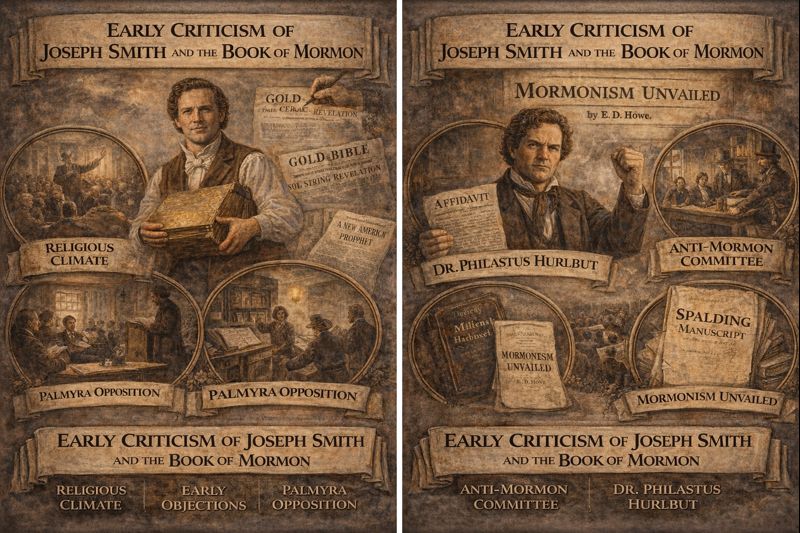
Early Criticism of Joseph Smith and the Book of Mormon – Part 1
Religious Climate in the Early 19th Century
During the early 1800s in the United States, particularly in western New York, the religious environment was characterized by revivalism, competition among denominations, and widespread interest in personal conversion. This period is often associated with the “Burned-over District,” a region heavily influenced by repeated revival meetings. Multiple churches, including Methodist, Baptist, and Presbyterian congregations, were active in proselytizing and defending doctrinal positions. The intensity of public debate made the area highly sensitive to new religious claims.
Joseph Smith’s Early Claims
Joseph Smith reported visions during his youth, including a visitation in 1820 and subsequent revelations related to the recovery of ancient records. Beginning in the mid-1820s, he described receiving divine instruction regarding plates containing historical and religious material. These claims were recorded and circulated among local communities before the publication of the Book of Mormon.
Initial Local Reactions
Reactions from neighbors, clergy, and community members varied. While some individuals offered support or curiosity, others expressed skepticism. Opposition emerged as Smith described supernatural events, the presence of gold plates, and angelic visitations. Local ministers in some cases rejected his claims as inconsistent with their theological views. Critics also questioned the possibility of ancient records preserved in upstate New York.
Role of Early Newspapers
Newspapers in the region played an important role in forming public opinion. Papers in Palmyra, Canandaigua, Rochester, and surrounding towns published commentary on new religious movements. In 1829 and 1830, articles and notices concerning Joseph Smith and the forthcoming Book of Mormon began to appear. Some newspapers reprinted statements, letters, or commentary from local residents. Many early reports reflected the editors’ opinions or the competitive religious environment of the day.
Alexander Campbell and Doctrinal Critique
Alexander Campbell, a prominent figure in the Restorationist movement, published one of the earliest extended critiques of the Book of Mormon shortly after its release in 1830. Campbell examined doctrinal themes and argued that the text reflected contemporary American religious debates. His review appeared in The Millennial Harbinger and contributed to a wider discussion of Joseph Smith’s claims among religious leaders. Campbell’s influence and his established readership allowed his critique to circulate broadly.
Palmyra and Local Opposition (1829–1830)
Palmyra, New York, where the Book of Mormon was printed in 1829–1830, was a small town with active printing establishments and politically engaged citizens. Local printers such as E. B. Grandin, who produced the first edition of the Book of Mormon, worked in an environment where news circulated quickly through word of mouth and the press. Reports about Smith, his associates, and the translation process were disseminated in the area. Public discussions often reflected the broader tensions between established churches and emerging religious movements.
Broader Public Controversy
By 1830, as the Book of Mormon was distributed and the Church of Christ was organized, national attention increased. Critics, religious leaders, and newspaper editors debated the authenticity of the text, the nature of Smith’s revelations, and the movement’s rapid growth. This period marked the beginning of organized opposition, with some individuals promoting alternative interpretations of Smith’s experiences and questioning his credibility.
Circulation of Claims and Counterclaims
Early antagonism often involved the publication of statements, affidavits, pamphlets, and editorials. Some accounts were written by neighbors or former associates, while others came from clergy engaged in theological disputes. Supporters and critics both used print culture to advance their perspectives. The exchange of claims and counterclaims contributed to the formation of early narratives surrounding Joseph Smith’s role and the origins of the movement.
Early Criticism of Joseph Smith and the Book of Mormon – Part 2
Early Critics Before the Book of Mormon
Jonathan Hadley (1829)
Before the Book of Mormon was published, Jonathan Hadley criticized Joseph Smith as too uneducated and illiterate to produce anything of significance. His argument was that Joseph’s lack of education proved the claims about the golden plates must be fraudulent.
Alexander Campbell (1831)
After the Book of Mormon was published and early converts appeared, Campbell argued the opposite: Joseph Smith wrote the entire book himself, consciously fabricating it. Campbell dismissed the book as inconsistent and impossible to be ancient.
These two early critics represent opposite claims: one insisted Joseph could not write the book; the other insisted Joseph did write it.
Dr. Philastus Hurlbut and His Role
Background
Philastus Hurlbut (first name literally “Doctor,” not a title) was an early convert in Ohio. Sent on a mission to western Pennsylvania, he was accused of multiple instances of adultery. On June 3, 1833, a church court in Kirtland excommunicated him for “unchristian conduct with the female sex.”
Attempt at Reinstatement
Hurlbut appealed to Joseph Smith personally. Joseph reaffirmed that excommunication was correct but restored him to fellowship due to apparent repentance. Soon after, Hurlbut bragged publicly that he had deceived Joseph and immediately attempted further immoral conduct. He was excommunicated a second time.
Threats Against Joseph Smith
After his second excommunication, Hurlbut vowed publicly to destroy Mormonism. He allegedly declared he would “wash his hands in the blood of Joseph Smith.” A non-Latter-day Saint judge ruled that Hurlbut had made threats “to wound, beat, or kill Joseph Smith,” requiring him to post a bond for good behavior.
Joseph Smith’s Letter
In a surviving letter, Joseph Smith wrote that Hurlbut had been “expelled from the church for lewd and adulterous conduct,” was “lying in a wonderful manner,” and that people were paying him to “break down Mormonism,” which endangered Joseph’s life.
Anti-Mormon Opposition in Kirtland (1833–34)
Growing Tensions
As hundreds of converts moved into Kirtland, economic concerns increased, political influence of Latter-day Saints expanded, and religious anxieties intensified. These pressures led to organized resistance.
The “Anti-Mormon Committee”
Local opponents formed an official group called the Anti-Mormon Committee. According to Eber Howe, “every legal means” was used to prevent Mormonism’s spread.
“Warning Out”
Townships used a legal mechanism called warning out to prevent undesirable newcomers from gaining residency. Warned-out individuals could not access public assistance and could not vote, preventing Latter-day Saints from gaining political influence. Even financially stable members like Frederick G. Williams were warned out.
Hurlbut’s Spalding Theory
After his excommunication, Hurlbut claimed he had discovered the “real source” of the Book of Mormon: a manuscript novel written by Solomon Spalding. He alleged that Joseph Smith (and later Sidney Rigdon) repurposed the manuscript and published it as scripture.
This theory attempted to explain both the Book of Mormon’s literary quality and the conversion of intelligent individuals.
Collection of Anti-Mormon Affidavits
Assignment
The Anti-Mormon Committee funded Hurlbut to travel in New York and Pennsylvania to gather affidavits hostile to the Smith family and statements supporting the Spalding theory.
Outcome
He returned with affidavits from individuals who knew the Smiths in Palmyra/Manchester, Emma Smith’s father Isaac Hale, and other neighbors. These uniformly portrayed the Smiths as dishonest, irreligious, or incompetent.
Publication of Mormonism Unvailed (1834)
Author: Eber D. Howe
An Ohio newspaper editor who published the first full-length anti-Mormon book, Mormonism Unvailed (original spelling).
Content
The book collected Hurlbut’s affidavits, accused Joseph Smith of fraud and moral corruption, and presented the Spalding theory as the origin of the Book of Mormon.
Dominance of the Spalding Theory (1834–1880s)
For over 50 years, the Spalding theory dominated criticism among professors, clergy, newspapers, and even the U.S. Congress.
Discovery of the Spalding Manuscript (1880s)
Discovery and Examination
James Fairchild and Lewis Rice discovered Spalding’s manuscript and compared it with the Book of Mormon, finding no resemblance.
Conclusions
Fairchild concluded there was no shared narrative, language, or structure, effectively destroying the Spalding theory.
Early Criticism of Joseph Smith and the Book of Mormon – Part 3
Persistence of the Spalding Theory
Despite being disproven, the theory persisted, later evolving into claims of a second lost manuscript—unsupported by evidence.
Shift to New Anti-Mormon Theories (20th Century)
“View of the Hebrews” (1823)
Written by Ethan Smith, proposing Native Americans descended from Israelites. Critics argue Joseph borrowed ideas, though no evidence shows he read the book. Overlap is conceptual, not textual.
“The Late War” (1816)
Written by Gilbert J. Hunt in biblical-style English. Critics argue stylistic similarity, but full-text comparisons show no narrative or conceptual connection.
Stylistic Context: King James English
Biblical language was widely used in the era for solemn writing and does not uniquely explain the Book of Mormon.
Historical Evaluation
Neither theory explains the Book of Mormon’s complex narrative, doctrine, structure, or rapid dictation process.
19th-Century American Perspectives on Native American Origins
The belief that Native Americans descended from Israelites was widespread and predated Ethan Smith by centuries.
Summary of Historical Developments in Anti-Mormon Theories
- 1830–1834: Joseph too ignorant vs. Joseph as deliberate fraud
- 1834–1880s: Spalding theory dominates
- 1880s: Spalding manuscript disproves theory
- Late 19th–20th century: Shift to new theories
- Modern scholarship: Rejects all major source theories
Links Referenced
- https://www.churchofjesuschrist.org/study/scriptures/dc-testament/dc/93
- https://www.britannica.com/topic/Arianism
- https://www.britannica.com/topic/Council-of-Nicaea
- https://www.josephsmithpapers.org
- https://www.fairlatterdaysaints.org