
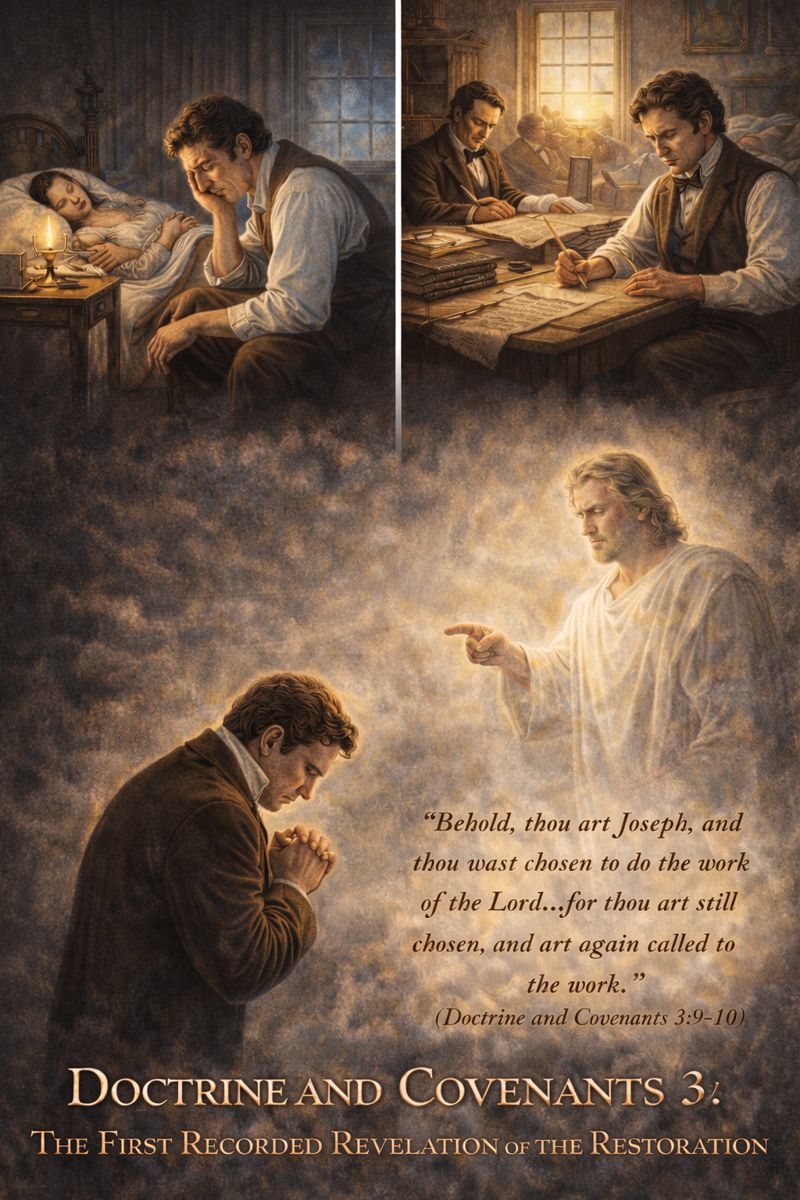
The Setting of the First Written Revelation
Doctrine and Covenants Section 3 stands as the earliest revelation ever recorded in writing during the Restoration, even though it appears third in the modern compilation. It emerged in July 1828 in the small community of Harmony, Pennsylvania, a place that had become Joseph and Emma Smith’s refuge from the hostility mounting in Palmyra and Manchester. Emma’s father, Isaac Hale, reluctantly permitted them to settle on his land, where Joseph purchased a small farm and began the work of translating the ancient record entrusted to him. This secluded location became the cradle of the first recorded revelation.
At this point in history, the Church had not yet been organized and the Book of Mormon had not been published. Although Joseph had already experienced the First Vision and years of angelic instruction from Moroni, those earlier manifestations had not been written down as dictated revelations. Section 3 is therefore the first moment the prophetic voice of the Restoration entered the written record.
Emma Smith’s Early Role in the Translation
In Harmony, long before Oliver Cowdery arrived in 1829, Emma Smith served as Joseph’s first scribe. Together they labored over what Joseph called the “Book of Lehi,” the initial portion of the record. Those early months were fragile, filled with spiritual intensity yet overshadowed by poverty, suspicion from neighbors, and Emma’s father’s disapproval. The translation moved slowly, and the emotional weight on Joseph and Emma was heavy even before the crisis that would soon unfold.
Martin Harris and the Rising Domestic Storm
Amid these early struggles, Martin Harris became one of Joseph Smith’s earliest and most resolute supporters. He provided not only financial help but also served briefly as a scribe. Yet in his own home, the opposition was fierce. Martin’s wife, Lucy Harris, denounced Joseph Smith repeatedly, insisted Martin was being deceived, and went to remarkable lengths to thwart the translation. She searched cupboards, trunks, and even holes she dug around the Smith home in Harmony. She removed furniture and belongings from her own home so that Martin could not secretly use them to support Joseph’s efforts. Each day Martin felt the ridicule of neighbors, the bitterness of his wife, and the humiliation of being viewed as a gullible man.
Under this pressure, Martin begged Joseph for permission to take the manuscript home to show his family and a small circle of trusted individuals. Joseph inquired of the Lord and was told no. After renewed pleading, Joseph petitioned again and still received a negative answer. Only after a third request did the Lord grant conditional permission. Martin covenanted strictly to show the pages only to those named. Carrying the roughly 116 pages with him, he left Harmony and—unknown to both Joseph and Emma—carried the future of the Restoration into the greatest early crisis it would ever face.
A Tragedy in Harmony
While Martin was in New York, tragedy struck Joseph and Emma. Their first child was born and died soon after birth. Emma nearly lost her own life in the ordeal, and Joseph kept vigil at her bedside for almost two weeks without sleep. It was only when Emma encouraged him, still pale and weak, that Joseph finally left to check on the safety of the manuscript. As he traveled by stagecoach to Palmyra, he felt deep foreboding. The plates and the interpreters had already been taken from him by the angel because he had insisted on permitting Martin’s request. Joseph sensed that something terrible had occurred.
Joseph’s Exhausting Journey and the Unknown Passenger
During the grueling journey, Joseph rode a twenty-four-hour stagecoach without rest. Another passenger, noticing his extreme exhaustion, insisted on walking the last miles with him through the night. The man, whose name was never learned by the Smith family, helped Joseph whenever he fell asleep while standing and guided him through the darkness until morning. Joseph finally arrived at his parents’ home completely spent.
The Silent Hours Before the Confession
Joseph’s parents immediately sent word to Martin Harris. Under normal circumstances Martin arrived promptly whenever summoned, but this time the morning passed in dreadful silence. Breakfast grew cold, then lunch approached, and still Martin did not appear. Only at 12:30 p.m.—six and a half hours late—did he slowly walk onto the property, sit on the fence with his face covered, and hesitate before entering the home. The air was thick with dread.
“I Have Lost My Soul!”
When Martin finally entered the home and attempted to sit at the table, he trembled so badly he could not hold his utensils. When asked if he was ill, he pressed his hands to his temples and cried out, “Oh, I have lost my soul! I have lost my soul!”
Joseph leapt to his feet and demanded to know whether he had broken his covenant. Martin admitted the manuscript was gone and that he did not know where it had gone. Joseph exclaimed in anguish, “All is lost!” The household erupted in grief. Lucy Mack Smith later described the scene as one of deep mourning, the family fearing that their hopes “had fled forever.”
For Joseph, the tragedy compounded everything he had recently endured: his child’s death, Emma’s near-fatal ordeal, the removal of the plates, and now the loss of the only manuscript of the Book of Mormon’s opening narrative. It seemed to Joseph that heaven had turned against him.
The Return to Harmony and Joseph’s Plea for Mercy
When Joseph returned to Emma, he told her what had happened. He believed he had forfeited divine favor and prayed desperately for forgiveness. In response to his pleading, the angel appeared and told him he had sinned by entrusting the manuscript to an unfaithful man. The plates and interpreters would not be returned until Joseph humbled himself and was forgiven.
It was in this moment of despair that the Lord dictated the revelation now known as Doctrine and Covenants 3—the first revelation ever written down in this dispensation.
The Voice of the Lord in the First Recorded Revelation
Section 3 is a remarkable mixture of rebuke and mercy. It declares that the works and designs of God cannot be frustrated, and that failure belongs to men, not to heaven. The Lord told Joseph he had feared man more than God, yet also affirmed that he was still chosen and called again to the work. The revelation promised that the Book of Mormon would come forth despite the loss of the manuscript and that God had preserved the record for His own purposes. For Joseph, burdened by grief and guilt, these words restored hope, identity, and purpose.
Renewal After the Darkness
Joseph remained emotionally crushed for weeks after receiving the revelation, and the Smith family did not hear from him for two months. But when they finally arrived in Harmony, Joseph came out to greet them with renewed confidence and joy, explaining how forgiveness had come and how the Lord had assured him that the Restoration would go forward. D&C 3 thus marks not only the first written revelation but also the moment Joseph’s prophetic calling was saved from collapse.
The Central Historical Meaning of These Events
Together, the events surrounding the loss of the 116 pages form one of the most defining crises in early Restoration history. They reveal Joseph Smith’s vulnerability, the intense opposition he faced, the tragedy that marked his early family life, and the immense spiritual burden of his calling. They also introduce the written prophetic voice that would guide the Church for generations. Through D&C 3, the Lord reaffirmed that His work would go forward, that human error could not halt divine plans, and that Joseph, though rebuked, remained His chosen instrument.
Podcast Context and Focus on Doctrine and Covenants 3
The Standard of Truth podcast episode examines the historical background of Doctrine and Covenants 3
It focuses on the loss of the 116 manuscript pages the emotional and spiritual crisis that followed and the first recorded revelation of the Restoration given to Joseph Smith
Joseph Smiths Situation Before the Journey
Joseph Smith had recently allowed Martin Harris to take the first 116 pages of the Book of Mormon translation to show to selected family members
During this same period Joseph and Emma had just buried their firstborn child
Emma was left in a very fragile health condition and Joseph feared she might die while he was away
Joseph already knew he was under divine displeasure because he had pressed the Lord repeatedly to let Martin take the pages against earlier instructions
Joseph Smiths Stagecoach Journey and Extreme Exhaustion
Joseph traveled by stagecoach toward New York to learn what had happened to the manuscript pages
He rode through the night refusing food and sleep because of grief anxiety and spiritual torment
By the time he left the stage he still had about twenty miles to walk on foot to reach his parents home
The Kind Stranger Who Escorted Joseph Through the Night
A fellow traveler on the stage noticed Joseph had neither eaten nor slept and insisted on accompanying him the remaining distance
The stranger warned that Joseph might collapse in the forest from exhaustion and offered to walk with him through the night
When they reached the Smith home near daybreak Joseph was so weak that the stranger had to lead him by the arm
The man advised Lucy Mack Smith to give Joseph something hot such as pepper in order to warm and strengthen his stomach
After eating briefly Joseph asked the family to send immediately for Martin Harris
Martin Harris Arrives With the Terrible News
Martin Harris usually responded quickly when invited to the Smith home
This time the family prepared breakfast around six in the morning expecting him to arrive soon
They waited hour after hour
Eight oclock passed then nine then ten then eleven
Martin finally arrived around half past twelve walking slowly with his eyes fixed on the ground
Instead of entering quickly he sat on the fence near the gate with his hat pulled down over his face
When he came inside and sat at the table he lifted his knife and fork then let them fall from his hands unable to eat
Hyrum Smith asked if he was sick
Martin pressed his hands to his temples and cried out that he had lost his soul
Joseph immediately leaped up asking whether Martin had lost the manuscript and broken his covenant
Martin admitted that the pages were gone despite searching the house and even opening mattresses and pillows
Joseph Smiths Anguish and Fear of Eternal Condemnation
Upon hearing the confession Joseph exclaimed that all was lost and asked whether condemnation had come upon both of them
Joseph believed they had broken sacred covenants with God by disobeying direct instructions about the safety of the manuscript
Because early nineteenth century Christianity often linked tragedy to divine wrath Joseph likely feared that the death of his child the severe illness of Emma the loss of the plates and the missing manuscript were signs of Gods anger
The Smith family wept and lamented for the rest of the day convinced that the work of translation might be destroyed and that Joseph himself might be eternally condemned
Return to Harmony and Pleading for Mercy
The next morning Joseph returned to Harmony to face Emma and tell her that the manuscript was gone
He felt that he had lost not only the pages but also the plates the favor of God and possibly his own salvation
Once home he prayed with great intensity begging God for forgiveness and mercy and asking if there was any way the work could continue
The Angelic Visitation and Removal of the Plates
During this period of deep repentance an angel appeared to Joseph
The angel declared that Joseph had sinned by delivering the manuscript into the hands of a wicked man
Because Joseph had made himself responsible for Martins faithfulness he would now suffer the consequences of that choice
The angel required Joseph to give up the plates
However the messenger also stated that if Joseph humbled himself and repented sincerely he might in time receive the plates again
Doctrine and Covenants 3 The First Recorded Revelation of the Restoration
Shortly after this rebuke Joseph received a revelation from the Lord now known as Doctrine and Covenants 3
It is the earliest revelation written and preserved in this dispensation
The revelation declares that the works and designs and purposes of God cannot be frustrated and cannot fail
The Lord teaches that it is the work of men that is frustrated not the work of God
Joseph is reminded that he had been given strict commandments and promises but had transgressed by following the persuasions of men and fearing man more than God
He is told that if he had trusted fully in God the Lord would have supported him against all opposition
Key Doctrinal Themes in Doctrine and Covenants 3
Gods work is unstoppable
The revelation teaches that divine purposes will move forward even when human agents fail or sin
The translation of the Book of Mormon and the gathering of Israel were part of an unfrustratable plan
Human weakness and the danger of fearing man
Joseph is warned against setting aside the counsel of God in order to satisfy the desires or expectations of others
The Lord explains that transgression came because Joseph listened to the persuasions of men instead of trusting divine instruction
Gods mercy and continued calling
One of the most powerful statements in the revelation affirms that God is merciful
If Joseph repents of what he has done that was contrary to Gods commandment he is still chosen and again called to the work
Despite his serious mistake his prophetic calling remains in place upon conditions of repentance
The purpose of the plates and the salvation of the Lamanites
The revelation also repeats the covenant purposes behind the Nephite record
The plates were preserved so that knowledge of the Savior would come to the descendants of the Nephites Lamanites and others
Through this knowledge they might repent believe the gospel rely on the merits of Jesus Christ and be saved
Joseph Smiths Renewed Joy After Forgiveness
For about two months the Smith family heard nothing from Joseph and worried deeply about his state of mind
Eventually Lucy and the family traveled to Harmony to visit him
As they approached Joseph came out to meet them while they were still some distance away his face radiant with joy
That joy came not only from seeing his parents but from having received forgiveness and revelation from the Lord
He carefully related to them how the Lord had chastened him how the plates had been taken and how the Lord had promised that the work would yet go forward
Lessons on Repentance and Divine Mercy
The story behind Doctrine and Covenants 3 shows that even a prophet can make serious mistakes and yet find forgiveness
Joseph broke a solemn covenant entrusted to him by an angel yet God disciplined him in love and reaffirmed his calling
The revelation assures all disciples that Gods work will not fail that sincere repentance is always possible and that through the mercy of Jesus Christ we can be forgiven and still be chosen to labor in the Lords work