
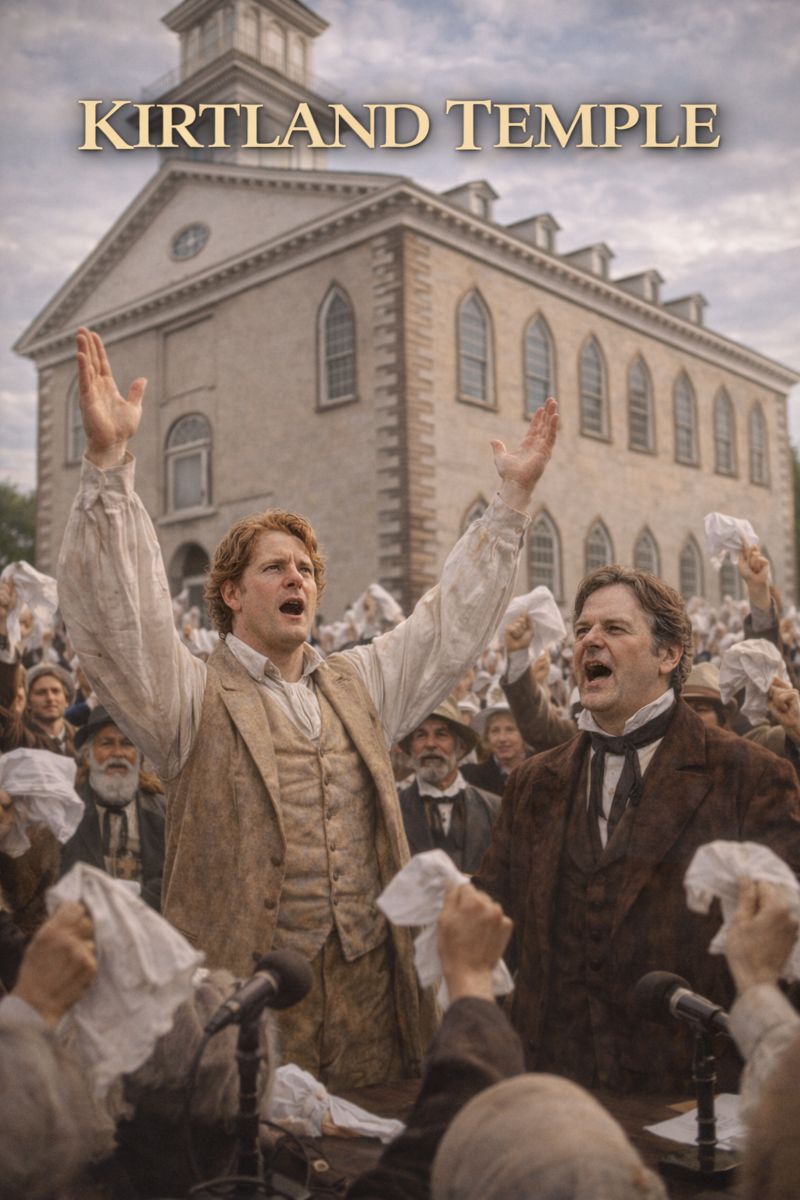
Kirtland Temple
Introduction: The Context of the Hosanna Shout
This bonus episode revisits the historical origins of the Hosanna Shout, a subject featured earlier in Season 3. The topic is especially meaningful now that the Church of Jesus Christ of Latter-day Saints has obtained stewardship over the Kirtland Temple and associated historic sites. With this transition, many Latter-day Saints have renewed interest in how temple worship developed in the earliest years of the Restoration. The Hosanna Shout, deeply rooted in scripture and revealed temple worship, provides a window into those early sacred experiences.
Scriptural Foundation of “Hosanna”
The term Hosanna appears most prominently in the New Testament during Jesus Christ’s triumphal entry into Jerusalem. According to Mark 11:8–10, the people placed garments and branches before Christ and cried:
“Hosanna! Blessed is he that cometh in the name of the Lord… Hosanna in the highest.”
The word itself expresses a plea for divine help—“save us, I beseech thee”—and became both a cry for deliverance and an expression of praise. These dual meanings naturally carried into Restoration scripture and worship.
Early Restoration Revelations Using the Word “Hosanna”
One of the earliest uses of Hosanna in the Restoration appears in Doctrine and Covenants 19, a revelation given to Martin Harris in 1829. At the close of the revelation, Martin is commanded to preach repentance “with a loud voice, with a sound of rejoicing, crying Hosanna, Hosanna, blessed be the name of the Lord God.”
This is significant: long before the Kirtland Temple, before the Church was formally organized, the Lord linked Hosanna to joyful proclamation, covenant sacrifice, and divine mercy.
Kirtland Temple Preparatory Anointings (January 1836)
As the Saints prepared for the Kirtland Temple dedication, Joseph Smith recorded a series of anointings and spiritual manifestations in January 1836. These events formed the foundation for temple worship.
Joseph wrote that he anointed the First Presidency and other quorums. Sylvester Smith later testified that a pillar of fire rested upon the heads of those assembled. After sealing the blessings, Sidney Rigdon lifted his hands and cried out “Hosanna!” He instructed the congregation to join in: “Hosanna to God and the Lamb, and glory to God in the highest.”
This moment stands as one of the earliest instances of a group Hosanna-like shout among Latter-day Saints.
The Kirtland Temple Dedication (March 27, 1836)
The dedicatory prayer, now canonized as Doctrine and Covenants 109, reveals the spiritual purpose of the Hosanna Shout. The prayer pleads that the Saints may “mingle their voices with the bright shining seraphs… singing Hosanna to God and the Lamb.”
During the dedication, the Saints sang “The Spirit of God,” a hymn that repeats the phrase “Hosanna to God and the Lamb.” At the conclusion of the service, Sidney Rigdon closed with a prayer that ended in repeated acclamations:
“Hosanna! Hosanna! Hosanna to God and the Lamb! Amen, Amen, and Amen.”
Brigham Young then spoke in tongues, followed by interpretation through David W. Patten. This is the earliest complete, documented performance of the Hosanna Shout. Notably, there is no evidence of handkerchief-waving during the 1836 dedication; that tradition develops later.
Heber C. Kimball’s 1862 Reflection
Heber C. Kimball later explained that the Hosanna Shout had been revealed to Joseph Smith in connection with the Kirtland endowment. He described it as an ordinance parallel to ancient apostolic worship in Jerusalem. Kimball recounted how, after the quorums were organized and anointed, all assembled stood together and cried:
“Hosanna! Hosanna! Hosanna to God and the Lamb! Amen! Amen! Amen!”
Kimball consistently emphasized its sacredness, its revealed nature, and the power that accompanied it. Again, he made no reference to handkerchiefs, underscoring that this element was still not part of the ceremony.
The Salt Lake Temple Capstone Ceremony (April 6, 1892): Introduction of Handkerchief-Waving
Lorenzo Snow’s Instruction
Lorenzo Snow taught the Saints that the shout originated in Kirtland and should be used only for extraordinary sacred occasions. He carefully instructed the tens of thousands gathered on how to perform the shout properly:
“Hosanna! Hosanna! Hosanna to God and the Lamb! Amen! Amen! Amen!”
This time, participants were directed to wave handkerchiefs on the word Hosanna.
President Wilford Woodruff’s Remarks
President Woodruff affirmed that the heavens took notice of the sacred scene. He connected the shout to the doctrine of salvation for the dead, one of the greatest revelations Joseph Smith received. Woodruff reminded the Saints that ancient prophets and early Church leaders witnessed the moment with joy.
The Shout
When the capstone settled into place, 40,000 Saints raised their voices in unison. A contemporary newspaper described a sea of handkerchiefs “of every color imaginable,” though white predominated. The effect was “grand beyond description.”
This ceremony firmly established handkerchief-waving as part of the modern Hosanna Shout.
The Modern Hosanna Shout
Since 1892, the Hosanna Shout has followed a consistent pattern:
instruction beforehand,
threefold repetition,
use of white handkerchiefs,
reserved for sacred milestones such as temple dedications and special commemorations.
President Russell M. Nelson continued this tradition, most recently during major temple dedications and the bicentennial commemoration of the First Vision.
Doctrinal Significance of the Hosanna Shout
Across nearly two centuries, the Hosanna Shout has carried profound meaning:
it is a revealed ordinance, not simply a ritual,
it unites Saints in collective praise,
it connects present worship with ancient discipleship,
it expresses gratitude for Christ and His Atonement,
it welcomes heavenly beings into sacred moments,
it reminds us that temples are built to redeem the dead,
and it encapsulates the hope of the Restoration—eternal life through Jesus Christ.
The shout calls heaven and earth together in worship. It is both a remembrance of what God has done and a petition for what He will yet do.
Listen to the full podcast here:
https://www.youtube.com/@standardoftruthpodcastllc
Season 4, Bonus Episode 3 – Bonus 3 – Dedication of the Kirtland Temple